The Special
Ones
CHAPTER #5
The Special Ones
A mark could be explained. A halo could be covered, an eye could be shaded, a strange wing could be folded and, with practice, almost forgotten. The lineages had begun, in their separate ways, to make room for the marked generation, because the marks still lived on bodies they recognized.
Then the eggs began to hatch bodies that no lineage recognized at all.
The first was born in a high valley, where the wind comes down off the bare stone and the nests are built close against the cold. The chick broke his shell at dusk, and his mother looked down at horns, small and dark and unmistakable, curving where no Hoot had ever carried horns. His feathers held a deep red warmth, and when the other chicks of the hollow shivered in the night wind, he did not shiver. A faint heat moved under his skin like banked coals, and in the dark his silhouette steamed, very slightly, where the frost touched him.
The valley did not know what he was. The valley decided quickly what he was not. He was not one of theirs.
Word travelled the old roads, faster than good news ever had, because fear is the lightest cargo a messenger can carry. On the plains, a chick had hatched grey and still, her light gone out before her first cry, and the mourning had already begun when, an hour later, the light returned, changed, patient, burning at a depth no one could see. In the streets of men, a City Hoot swore she had seen a round, calm stranger, black and white as winter water, who belonged to no lineage and seemed entirely at peace with that. Each nest that heard the stories looked at its own eggs with new eyes, and dreaded them a little, and loved them a little less openly, which is how dread works when it is allowed to stay.
The high valley solved its fear the way frightened communities have always solved it. When the horned chick fledged, strong and warm and bewildered, the elders of the valley gave him the sky and took away the ground. Fly, they told him. Fly anywhere. Only not here.
He flew badly, the way the newly exiled fly, stopping often, calling sometimes at empty ridges in the night. It was the keeper of the katana who found him, asleep and frost rimed on the old road, still too young to know that roads have keepers at all. The keeper had sworn, long before, to open roads and to cut the trapped free, and he judged the chick with the only judgment his oath allowed. He woke him, fed him from his own stores, and carried the word of him down to the deep forest, and the chick himself, walking and flying by turns, behind the one Hoot in the world who had not asked what he was before asking whether he was hungry.
The elder of the Forest received him under the oldest canopy, and the hollow held its breath, because she was very old now, and the effort of the council had marked her, and her word would settle what the chick's life meant.
She looked at him for a long time. Then she did a thing no one expected. She leaned her ancient head close to his small horned one, the way a mother checks a chick for fever, and she stayed there, feeling the warmth move under his skin.
"There it is," she said at last, to the whole hollow. "The same fire. The same fragment. It has only changed its coat."
A Forest Hoot in the shadows asked the question the high valley had asked. "Then what is he?"
"He is what the fragment is trying next," the elder said. "Listen to me, because this is the last time I will say it to frightened Hoots. The light is going out of the world in a way none of our songs describe. The fragments know it. They are reaching for every shape that might survive what comes. A body that carries its own fire into the cold. A body whose light can go out and come back, and not fear the road between. Forms we find ugly. Forms we find impossible. The fragment is not asking our permission, and it is not making mistakes. It is making answers, faster than we are making room for them."
The horned chick stayed in the forest. Others followed, in ones and twos, down the old roads, out of nests that could not hold their strangeness: the grey ones whose light burned low and deep, the quiet round ones, the ones with the look of other weathers about them. The deep canopy, which had been the memory of the Hoots, became also their refuge, and the elder, who had waited a lifetime for the lineages to return, received instead the children the lineages could not keep.
She named none of them. Naming was never the Forest's gift. But she gave them the words the songs would use ever after. Not the cursed ones. Not the broken ones.
The special ones.
And on the last night of that season, when the refuge had settled and the fires burned low, a sentry on the forest's southern edge raised a call that no Hoot alive had ever raised. Something was coming out of the south, on foot, across the cold lowlands where no lineage nests. It walked upright and unhurried, black and white, built for a cold so complete that the valley of the horns would have seemed a warm country to it. It had crossed frozen seas to reach them. It had a message, and the message was not from any lineage.
The darkening, said the first of the Penguins, is not yours alone. It covers every sky I have flown under and swum beneath. And you are not the only ones it is happening to.
On the other side of the world, there are Hoots waiting too.
COMING NEXT
Next, in Chapter 6, The Dimming: the dark comes first to a forgotten valley, where a young messenger survives seven days inside the veil and walks out lightless, the first Hoot ever named for himself alone. And the elder of the Forest discovers where the darkness has truly been gathering, and what the lineages must do to stop it.
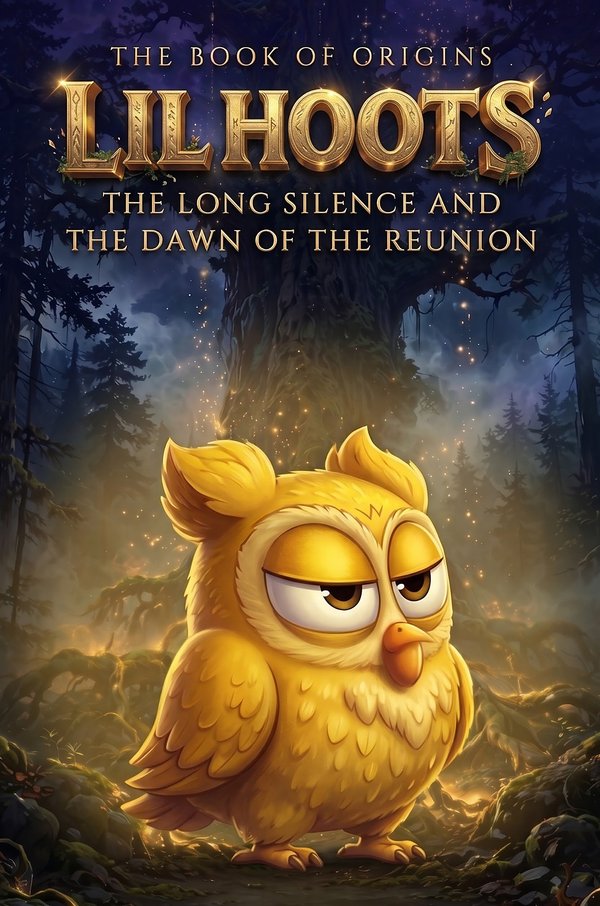
THE STORY CONTINUES IN THE BOOK
To keep reading, get the official book. The rest of the saga lives only there, with 143 illustrations from the collection itself, the Gallery of the Nine Uniques and the full Index of all 180 Traits.